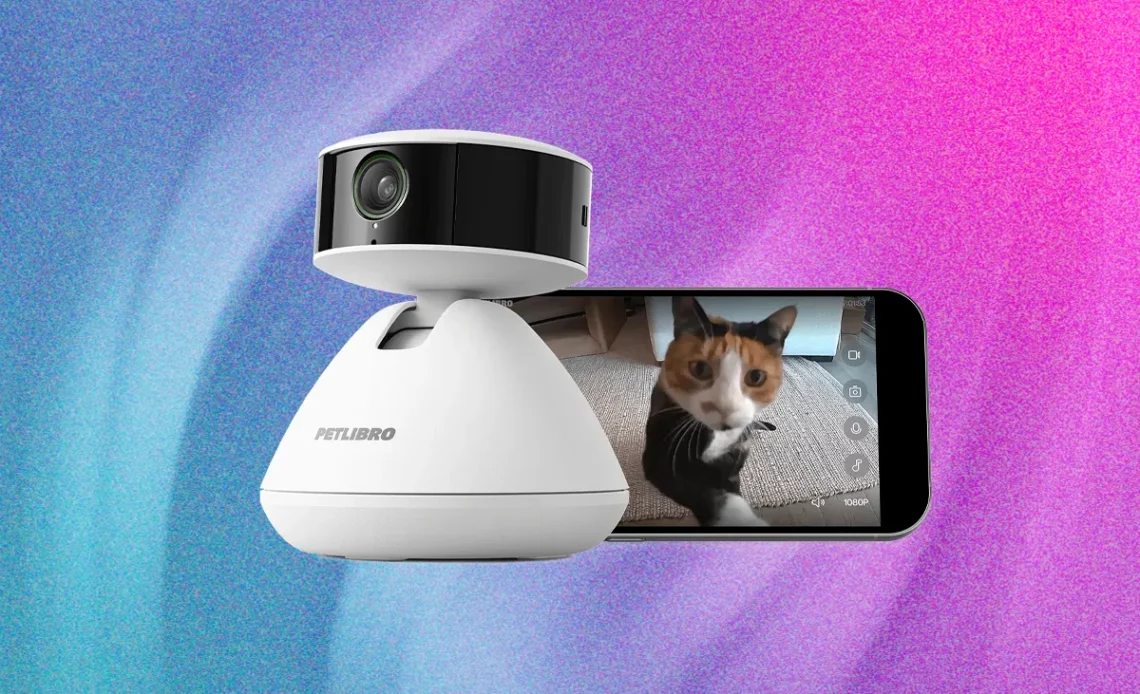
Pet tech company Petlibro, already known for its automatic feeders and smart water fountains, has expanded its product lineup with a new device that pushes well beyond basic surveillance. Its latest release, the Scout Smart Camera, combines traditional pet monitoring with AI-powered behavioral recognition and descriptive narration, creating a more interactive and personalized experience for pet owners.
While at first glance it resembles a standard indoor pet camera, Scout introduces a layer of intelligence that transforms how owners interpret their pets’ daily behavior.
A Familiar Pet Camera—With a Smarter Core
Like many competing devices, Scout functions as a real-time pet monitoring system. It streams video directly to a mobile app and includes two-way audio, allowing owners to speak to their pets remotely when they are away from home.
The camera can also be controlled manually through the app, giving users the ability to adjust its viewing angle. However, one of its more advanced features is automatic tracking: the device can detect movement and follow pets as they move through a room without requiring user input.
To further increase interaction, the camera includes attention-grabbing audio cues, such as soft chirping sounds designed to attract a pet’s attention if they are out of frame.
At this level, Scout remains comparable to existing smart pet cameras on the market. Its differentiation begins with its AI layer.
AI That Understands Pet Behavior
What sets Scout apart is its AI-based pet recognition and behavior tracking system. Instead of simply recording video, the camera attempts to interpret what it sees.
The system can identify specific actions such as:
- Eating or approaching food
- Drinking water
- Using the litter box
- Walking across a room or interacting with objects
These activities are then logged and organized into a timeline of pet behavior, giving owners a structured overview of daily routines.
The camera also generates automatic “highlight” clips, which are stored in the cloud for up to 30 days. In addition, it can capture spontaneous snapshots when a pet is detected, effectively creating a visual diary of daily activity.
One of the more playful features is its ability to recognize multiple pets—currently up to two profiles—allowing the system to distinguish between animals and track them separately within the same household.
From Data to Descriptions: AI Narration of Pet Life
Where Scout becomes particularly distinctive is in how it translates data into language.
Instead of simply alerting owners with notifications like “pet detected” or “activity recorded,” the system generates natural-language descriptions of pet behavior. These descriptions read almost like short observational narratives.
For example, instead of a basic alert, users might receive a sentence describing their pet’s movement and demeanor in a more expressive form, turning routine activity tracking into something closer to storytelling.
This narrative layer is designed to make monitoring more engaging and emotionally connected, especially for owners who spend long hours away from home.
Learning and Adapting Through Use
According to Petlibro’s founder and CEO York Wu, one of the biggest technical challenges was distinguishing between multiple pets in dynamic environments. Traditional facial recognition methods struggled when animals moved quickly or shared similar physical features.
To address this, the company developed a feedback-driven recognition system that improves over time based on real-world usage. In other words, the camera learns from corrections made by the owner, gradually improving its accuracy in identifying individual pets.
If the system mislabels a pet, users can manually correct it through the app. These corrections are then used to refine future recognition performance.
This creates a personalized AI model that becomes more accurate the longer it is used in a specific household.
Multi-User Access and Shared Pet Monitoring
Another practical feature is multi-user access. The system allows up to five additional users to share access to the same camera feed.
This is particularly useful for families or shared households where multiple people are responsible for pet care. It ensures that everyone stays informed about the pet’s activity without relying on a single account.
Pricing and Subscription Model
The Scout Smart Camera is priced at approximately $100, positioning it competitively within the smart pet camera market.
However, much of its advanced functionality relies on a subscription model:
- Standard AI features: ~$12 per month
- Premium tier: ~$17 per month
These subscriptions unlock the AI-powered recognition system, behavioral summaries, and cloud storage features.
Without a subscription, the device functions primarily as a basic streaming camera with limited intelligence features.
Competition in the AI Pet Camera Market
Petlibro is not alone in this space. Competitors such as Furbo offer similar smart pet monitoring devices, some of which include AI-based behavioral assistants and additional features like bark detection.
Furbo’s pricing model differs, with its hardware costing significantly more, while some AI features are available at a lower monthly subscription rate.
At the moment, Petlibro’s Scout camera lacks certain features such as barking detection or meowing alerts, though the company has indicated that these capabilities are under development. Integration with additional Petlibro devices such as feeders and fountains is also planned, suggesting a broader connected ecosystem strategy.
Data Collection and Privacy Considerations
As with many AI-powered smart devices, Scout collects visual data to improve its performance. According to the company’s privacy policy, image and video data may be used to refine AI models and enhance recognition accuracy.
Petlibro emphasizes that audio data is not used for AI training or processing.
The company also states that users effectively contribute to training their own personalized camera model. When owners correct misidentifications—such as labeling a pet correctly in the app—this feedback helps improve future accuracy for that specific device.
Additionally, users have the option to manually “donate” video clips to Petlibro for broader system improvements.
While this raises familiar questions about data usage in smart devices, Petlibro notes that all processing complies with applicable privacy regulations.
A Shift Toward Emotional AI in Pet Tech
Beyond its technical capabilities, Scout reflects a broader trend in consumer AI: the shift from purely functional tools to emotionally expressive systems.
Instead of simply tracking pets, the camera attempts to interpret and describe their behavior in human language, adding personality and narrative to routine activity monitoring.
This approach transforms passive surveillance into something more engaging—almost like a digital companion that narrates the daily life of a household pet.
Final Thoughts
Petlibro’s Scout Smart Camera sits at the intersection of AI, pet care, and consumer storytelling. It doesn’t just show what pets are doing—it tries to explain it in a way that feels personal and emotionally resonant.
While questions around privacy, subscriptions, and long-term accuracy remain, the direction is clear: pet tech is moving away from simple monitoring tools and toward intelligent systems that interpret and narrate everyday animal behavior.
In that sense, Scout is less about watching pets—and more about understanding them through the lens of AI.