



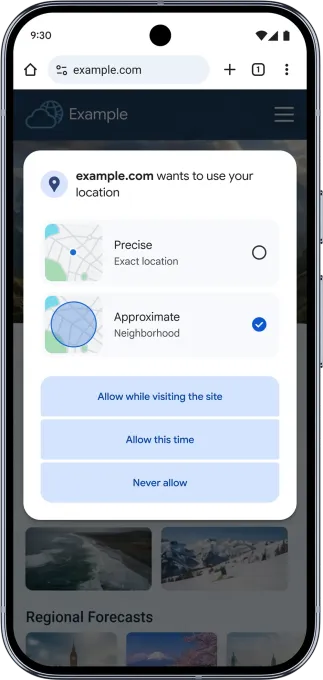
Google has officially rolled out a new privacy-focused update for Chrome on Android that changes how location data is shared with websites. Instead of automatically providing precise GPS coordinates, users can now choose to share an approximate location, marking an important step toward giving individuals more control over their personal data.
This change reflects a broader industry trend where major technology companies are rethinking how much sensitive information should be exposed by default, especially in everyday web browsing.

A More Flexible Approach to Location Data
Until now, Chrome on Android primarily allowed websites to request precise location data when a user granted permission. While this level of accuracy is useful in certain scenarios, it can also expose more information than necessary in situations where exact positioning is not required.
With the new update, Google introduces a more flexible system. Users will now be able to decide whether they want to share their exact location or a broader, less specific area instead.
According to Google, this distinction is important because not all online services need pinpoint accuracy. In many cases, a general idea of where a user is located is enough to deliver relevant content or functionality.
For example, a website showing local weather updates, news headlines, or regional recommendations does not necessarily need to know a user’s exact street location. In contrast, services like food delivery apps, ride-hailing platforms, or navigation tools still require precise coordinates to function correctly.
Google’s Position on Privacy and Control
In an official blog statement, Google emphasized that the new feature is designed to give users more meaningful control over how their data is shared with websites.
The company explained that users should not be forced into an all-or-nothing choice when it comes to location sharing. Instead, they should be able to adjust the level of precision depending on the context and their comfort level.
Google also reassured users that precise location sharing is still available when needed. If a website requires accurate positioning for essential functionality—such as mapping, navigation, or location-based ordering—the user can still grant full access.
This dual-option system aims to balance convenience and privacy without limiting the capabilities of modern web services.
Expansion Plans Beyond Android
While the feature is currently available on Chrome for Android, Google has confirmed that it plans to extend this capability to desktop versions of Chrome in the near future. This would bring a consistent privacy experience across devices, allowing users to maintain the same level of control whether they are browsing on mobile or computer.
However, the company has not yet provided a specific release timeline for desktop support. Additionally, Google has not confirmed whether or when similar functionality will be introduced for Chrome on iOS, leaving Apple users uncertain about future availability.
New Tools for Developers
Alongside the user-facing update, Google is also introducing new application programming interfaces (APIs) designed for web developers. These APIs will allow websites to request either approximate or precise location data depending on their specific needs.
This change encourages developers to think more carefully about why they are requesting location access in the first place. Instead of defaulting to precise location tracking, developers are now being urged to justify when such accuracy is truly necessary for their service to function properly.
For instance, a weather website could rely on approximate location data, while a mapping service might still require exact coordinates. This separation gives developers more flexibility while reinforcing privacy-conscious design practices.
A Small but Meaningful Step for Users
Although the update may seem minor at first glance, it represents a meaningful shift in how personal data is handled in everyday browsing. Users are no longer forced into sharing more information than necessary, and they gain the ability to tailor location permissions based on context.
Privacy advocates often argue that small adjustments like this can have a significant long-term impact, especially when adopted across widely used platforms such as Chrome. By reducing unnecessary precision in location sharing, Google is effectively minimizing the amount of sensitive data exposed during routine web activity.
Conclusion
The introduction of approximate location sharing in Chrome on Android highlights Google’s ongoing effort to refine user privacy controls while maintaining functionality for essential services. By separating approximate and precise location access, the company is offering a more nuanced approach that better reflects real-world usage.
As this feature expands to other platforms and developers begin adopting the new APIs, users may find themselves with greater transparency and control over how their digital footprint is shared online.